
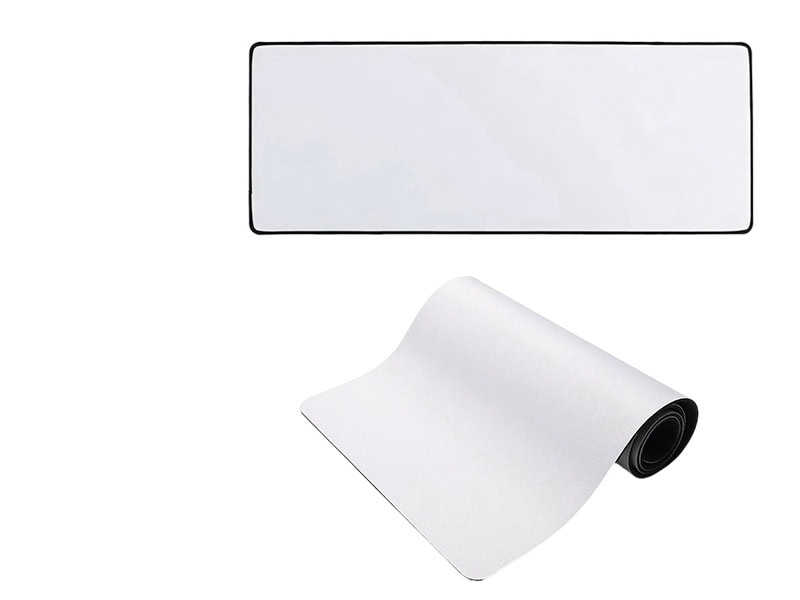
Introduction
Choosing between gaming mouse pads and office desk mats involves more than comparing their sizes or appearances. Although both products create a smoother, more organized desktop surface, they serve different users and purchasing needs. Gaming mouse pads are primarily designed around mouse tracking, speed, control, and stable performance during extended gameplay. Office desk mats place greater emphasis on desk protection, workspace organization, everyday comfort, and professional brand presentation.
For brands, wholesalers, and product buyers, the right choice depends on the customers they want to reach. A gaming accessories brand may need performance fabrics, non-slip rubber bases, stitched edges, and bold custom artwork. An office supply or corporate gift company may prefer larger coverage, understated colors, easy-to-clean materials, and prominent logo placement.
This guide compares their target markets, materials, specifications, branding opportunities, packaging requirements, and retail positioning to help you decide which option—or combination of both—best fits your product line.
Gaming Mouse Pads vs. Office Desk Mats: Quick Comparison
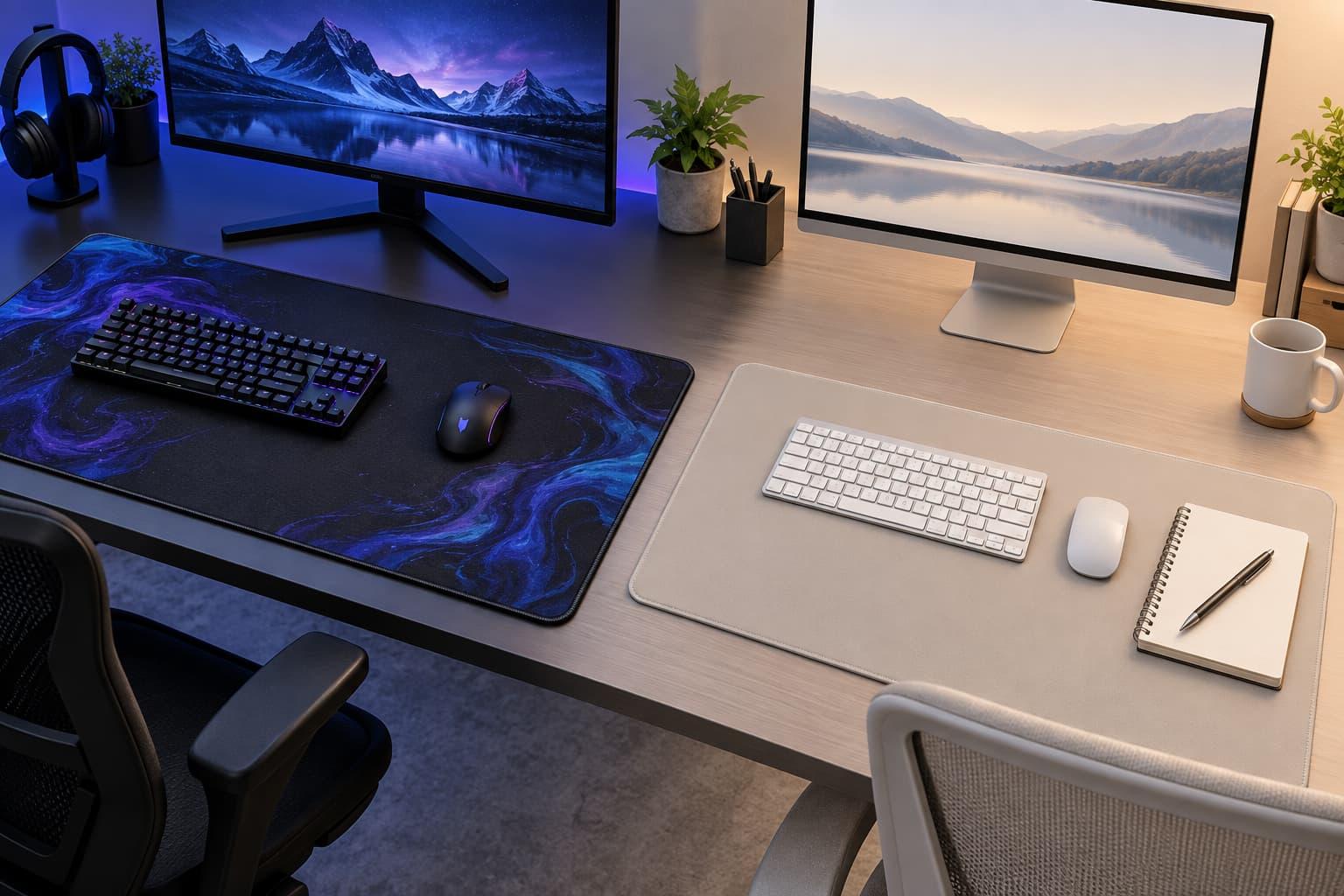
The main difference between gaming mouse pads and office desk mats lies in their product priorities. Gaming mouse pads are developed primarily for consistent mouse tracking, controlled glide, and stability during fast or precise movements. Office desk mats are designed to protect a larger section of the desk, organize the workspace, and create a clean, professional appearance.
The distinction is not based on size alone. Extended gaming mouse pads and office desk mats may both measure 900 × 400 mm, but their surfaces, design styles, and target customers can be very different. The following comparison provides a quick overview for brands and wholesale buyers.
| Comparison Factor | Gaming Mouse Pads | Office Desk Mats |
|---|---|---|
| Primary purpose | Accurate tracking, speed, control, and stability | Desk protection, workspace organization, and everyday comfort |
| Target users | Gamers, PC enthusiasts, and esports users | Office workers, remote workers, and corporate users |
| Common sizes | 300 × 250, 450 × 400, 490 × 420, and 900 × 400 mm | 600 × 350, 700 × 300, 800 × 400, and 900 × 400 mm |
| Typical thickness | 2–5 mm | 1.5–3 mm |
| Common surfaces | Lycra, polyester, micro-textured, or jacquard fabric | Fabric, PU leather, felt, or cork |
| Base materials | Natural rubber or high-density PU foam | Rubber, PU, felt, or cork |
| Key performance features | Mouse glide, stopping power, sensor tracking, and non-slip grip | Scratch protection, easy cleaning, writing comfort, and desk coverage |
| Design style | Gaming artwork, IP graphics, bold colors, or full-surface printing | Minimal designs, brand colors, corporate logos, or neutral finishes |
| Typical sales channels | Gaming brands, computer accessory stores, esports merchandise, and e-commerce | Office suppliers, corporate gift companies, lifestyle retailers, and home-office brands |
| Common customization | Surface performance, rubber base, edge stitching, artwork, and packaging | Material, size, color, logo application, edge finish, and packaging |
For a gaming peripheral brand, a performance-focused mouse pad usually provides a stronger connection with its target users. For an office supply, corporate gift, or lifestyle brand, a desk mat generally offers broader everyday use and more prominent brand exposure. Companies serving both markets can develop the two formats as complementary products rather than treating them as interchangeable options.
Which Product Fits Your Target Market?
The right product depends less on which format is generally “better” and more on who your customers are and why they would buy it. Some customers are looking for measurable gaming performance, while others value desk protection, professional appearance, brand visibility, or an affordable promotional item. Before selecting materials or dimensions, identify the main purchasing motivation within your target market.
Gaming Peripheral Brands
Best fit: Gaming mouse pads, including standard and extended sizes
For gaming peripheral brands, the mouse pad should strengthen an existing ecosystem of mice, keyboards, headsets, and other PC accessories. Customers in this market are likely to care about tracking consistency, glide, stopping power, base stability, and long-term durability.
Standard gaming mouse pads can target performance-focused users, while extended versions can create a coordinated gaming setup and provide more space for artwork. Brands can also develop speed, control, and balanced surfaces as separate product options for different player preferences. Gaming mouse pads are therefore not only an accessory but also an opportunity to extend brand identity across the entire desktop.
Office Supply Brands
Best fit: Office desk mats
Office supply buyers usually prioritize workspace organization, desk protection, easy maintenance, and broad everyday usability. Their customers are less likely to compare highly specialized surface performance, but they may care about whether the mat is comfortable, easy to clean, visually professional, and suitable for both writing and mouse use.
Neutral colors, understated textures, and practical sizes generally fit this market better than aggressive gaming graphics. Office supply brands can also offer several sizes or material options to serve corporate offices, home offices, schools, and shared workspaces.
Corporate Gift Companies
Best fit: Custom office desk mats or coordinated desk accessory sets
Corporate gift buyers are usually purchasing for employee onboarding, company events, client gifts, or internal brand programs. Their main priorities are useful daily exposure, reliable logo reproduction, attractive presentation, and a product that can appeal to a wide range of recipients.
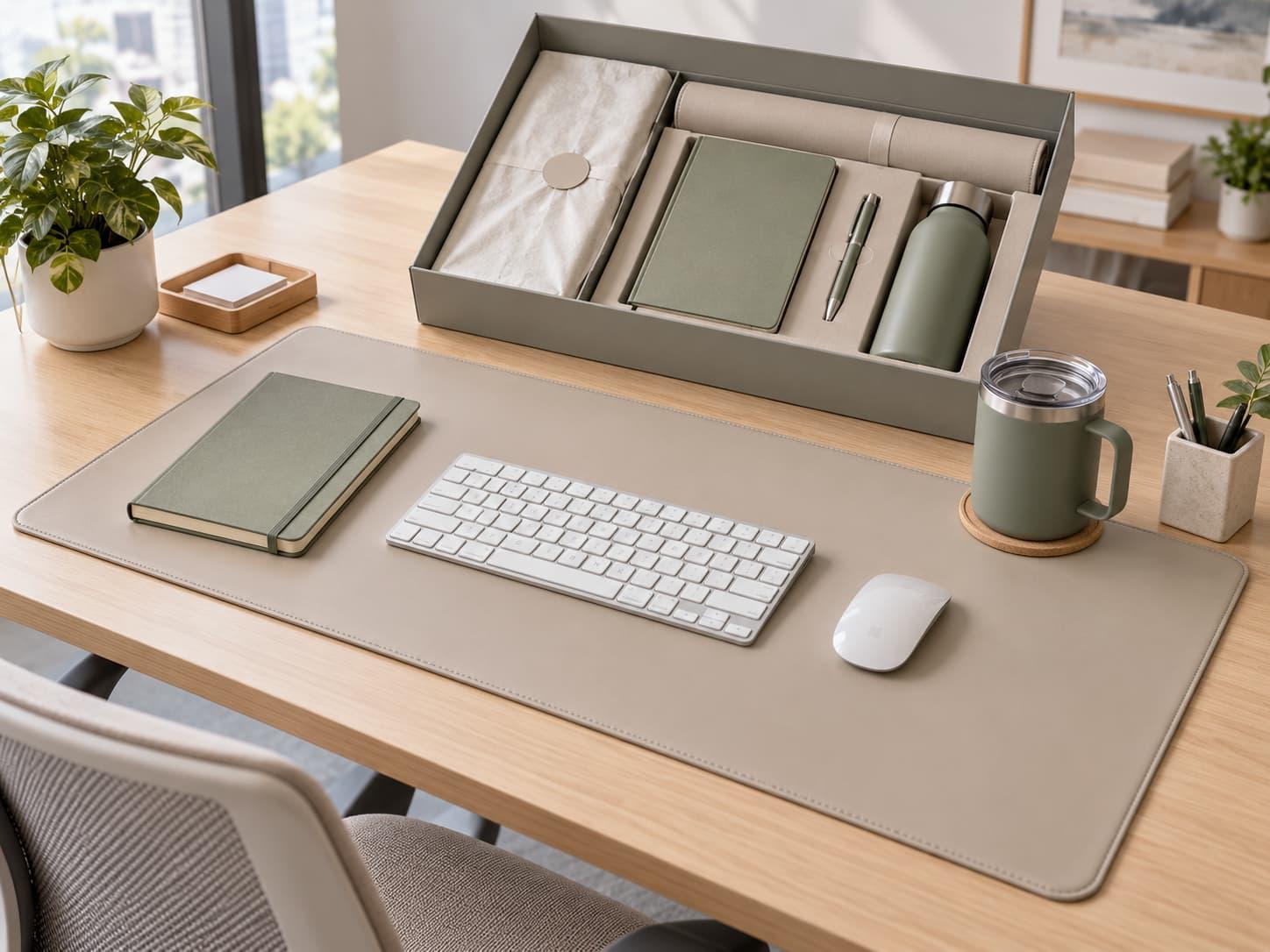
Office desk mats work well because they provide a large, visible branding area without requiring the recipient to be a gamer. A simple company logo, brand color, or custom pattern can be combined with a paper sleeve or gift box. For technology companies or younger audiences, an extended fabric desk mat may provide a suitable balance between gaming style and office practicality.
Promotional Product Distributors
Best fit: Depends on campaign budget and intended use
Promotional product distributors often serve customers with different quantities, budgets, deadlines, and campaign objectives. Smaller mouse pads are generally suitable for cost-sensitive promotions, trade shows, and large-volume giveaways. Larger desk mats create greater visual impact and may be positioned as higher-value corporate gifts or branded merchandise.
Instead of offering only one format, distributors can organize their range by price and application: standard promotional mouse pads for high-volume campaigns, fabric desk mats for full-color branding, and PU leather desk mats for more professional gift programs. This makes it easier to match each enquiry with an appropriate product rather than competing only on unit price.
Lifestyle and Home-Office Brands
Best fit: Office desk mats, especially design-led fabric or PU leather options
Customers buying from lifestyle and home-office brands often view a desk mat as part of the overall workspace rather than a standalone computer accessory. Color, texture, visual balance, and compatibility with different interior styles can be more influential than gaming performance.
These brands can differentiate their collections through seasonal colors, reversible designs, coordinated desk accessories, or premium-looking packaging. Fabric surfaces support printed patterns and illustrations, while PU leather is more suitable for solid colors, subtle logos, and minimalist collections. The product should feel consistent with the brand’s wider visual language.
Computer Accessory Wholesalers
Best fit: A mixed product range
Computer accessory wholesalers usually serve multiple customer groups, so relying on only one product type may limit sales opportunities. Standard gaming mouse pads can address performance and entry-level gaming demand, while extended gaming pads can be sold alongside keyboards and gaming mice. Office desk mats can serve business users, remote workers, corporate buyers, and general electronics retailers, and wholesalers often need bulk mouse pads that are widely suitable across different channels.
A practical wholesale range could include a few core sizes and price levels rather than too many similar SKUs. For example, the range might contain an affordable standard mouse pad in 220x180mm, a mainstream stitched gaming model, an extended printed gaming mat in 800x300mm, and a neutral office desk mat, with core wholesale models built for a long service life. This creates clear choices while keeping inventory and repeat ordering manageable.
Ultimately, the decision between gaming mouse pads and office desk mats should begin with one question: What is the main reason your customer will buy the product? Choose gaming mouse pads when performance, gaming identity, and compatibility with PC peripherals drive the purchase. Choose office desk mats when workspace protection, professional presentation, and everyday usefulness matter more. If your business serves both audiences, a focused combination of the two can provide broader market coverage without creating an unnecessarily complex product range.
Product Strategy: Build a Focused and Profitable Range
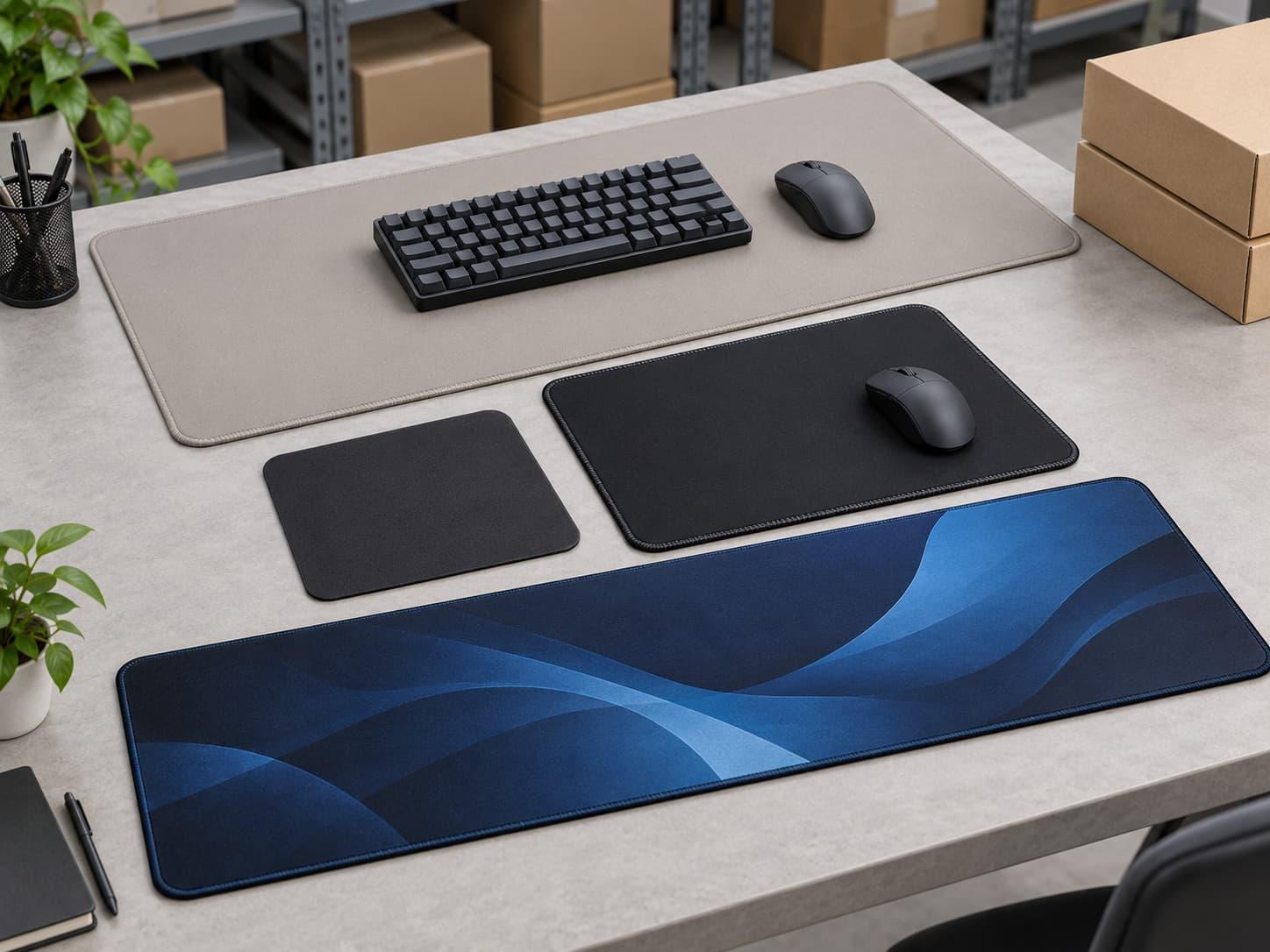
Once you know which customers you want to serve, the next step is to decide how the product fits into your existing range. The goal is not to offer every possible size, material, and finish. A focused collection with clear differences between products is usually easier to market, stock, and reorder.
If gaming accessories are your core business, start with one standard gaming mouse pad and one extended model. The standard version can focus on individual mouse performance and also reduce wear and tear on the mouse, while the extended version can accommodate both a keyboard and mouse and give more room for both items as well as more space for custom artwork. These products can be coordinated with your existing mice, keyboards, or headsets through shared colors, graphics, and packaging.
For an office, corporate gift, or lifestyle range, one practical fabric desk mat and one more refined PU leather option may provide enough variety. The fabric version supports full-color printing and promotional applications, while the PU leather version can serve buyers looking for a cleaner, more professional product.
Brands serving both markets do not necessarily need two completely separate collections. Gaming mouse pads and office desk mats can share selected dimensions, base materials, packaging components, or brand colors while maintaining different surfaces and visual styles. This can reduce development complexity without making the products feel identical.
A simple product strategy could be structured as follows:
| Product Role | Suggested Direction | Main Purpose |
|---|---|---|
| Entry-level option | Standard fabric mouse pad | Accessible pricing and volume sales |
| Core gaming option | Stitched natural rubber gaming mouse pad | Everyday gaming performance |
| Extended option | 800 × 300 or 900 × 400 mm printed mat | Keyboard-and-mouse setups |
| Office option | Neutral fabric or PU leather desk mat | Workspace protection and professional use |
Each SKU should have a clear reason to exist. If two products target the same customer, use the same material, and offer no meaningful difference in size, design, or price, one of them may be unnecessary. A smaller, clearly positioned range is often more effective than a large collection of similar products.
Branding should support this positioning rather than become a separate product decision. Bold artwork, IP graphics, and color-matched stitching work well for gaming collections, while restrained colors, subtle logos, and gift-ready packaging suit office products. The selected design should make the intended market immediately recognizable.
OEM Procurement: Turn the Product Plan into a Production Specification
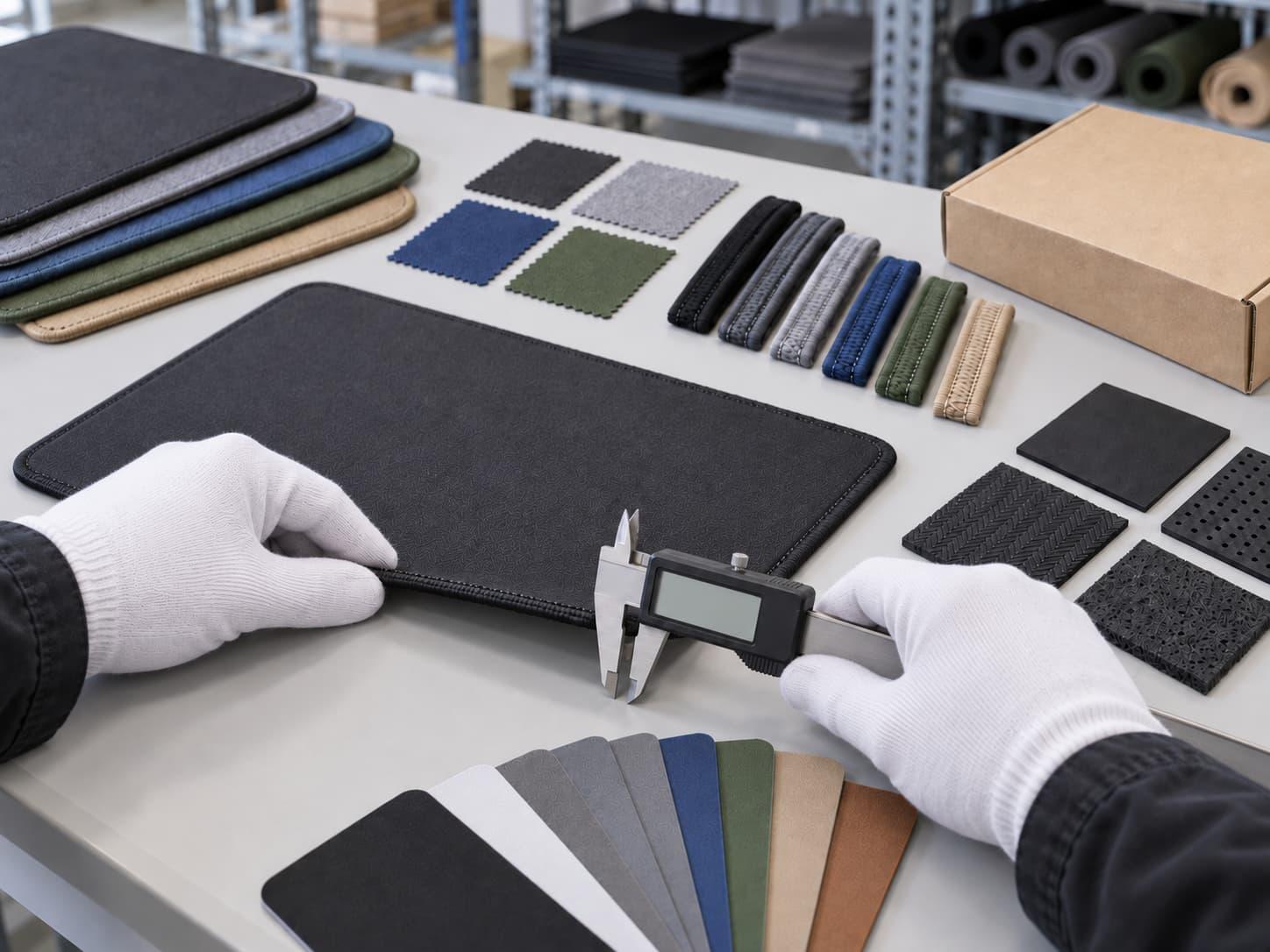
After defining the product range, convert each product idea into a clear OEM specification. This allows the manufacturer to recommend suitable materials, prepare accurate samples, and provide a quotation based on the same requirements.
For an OEM gaming mouse pad, the specification should include:
- Finished size and thickness
- Surface preference, such as speed, control, or balanced
- Fabric and rubber-base requirements, including whether natural rubber is required for maximum grip and whether a high thread count polyester surface is preferred for better mouse tracking
- Raw-cut, standard stitched, or recessed stitched edges
- Artwork and Pantone color requirements
- Logo or woven-label placement
- Individual packaging
- Estimated order quantity
- Target market and intended retail position; the factory may also manufacture custom mouse pads in different shapes, including round or square, when shape is part of the brief
Buyers sourcing wholesale gaming mouse pads should pay particular attention to the consistency between samples, bulk production, and repeat orders. Surface texture, rubber density, dimensions, print color, stitching, and odor can all affect the end-user experience. These requirements should be confirmed during sample development rather than after mass production begins. If a heat treated surface is required, it should also be specified and approved during development.
Office desk mat buyers should provide similar information but may need to place more emphasis on surface finish, cleaning requirements, writing comfort, logo application, and packaging presentation. Custom desk mats are commonly available in five sizes up to 18×36 inches and may use 3mm premium neoprene for durability. When evaluating a custom desk mat manufacturer, check whether the supplier can support the required material, printing or logo process, size tolerance, sample approval, quality inspection, and repeat-order records.
A practical OEM procurement process can be completed in four stages:
- Define the product brief: Confirm the target user, market position, size, material, design, packaging, quantity, and target price range.
- Develop and approve the sample: Check the actual surface feel, dimensions, color, stitching, base grip, logo position, and packaging.
- Confirm the production standard: Record the approved materials and tolerances so the bulk order follows the same specification, and check each stage against the approved standard.
- Inspect before shipment: Verify appearance, size, printing, workmanship, packing quantity, and carton condition before delivery. Buyers with tight launch schedules should also confirm whether express sample or shipment options are available.
Price should be evaluated together with product quality, packaging, order quantity, and freight efficiency. A lower unit cost may not provide better value if the material does not match the intended market or if inconsistent production leads to complaints and difficult repeat orders.
The most effective approach is to give the manufacturer a clear product objective rather than request a generic “best material” or “best price.” When the supplier understands who the product is for, how it will be sold, and where it sits in the range, it becomes easier to develop an OEM solution that supports both customer expectations and commercial goals, while clear specifications help the supplier deliver a more consistent final product.
Frequently Asked Questions
1. Should my brand choose gaming mouse pads or office desk mats?
Choose gaming mouse pads if your customers prioritize mouse control, tracking consistency, gaming aesthetics, and compatibility with PC peripherals, especially when the product is meant to improve the gaming experience during play. Office desk mats are more suitable when customers value desk protection, workspace organization, professional styling, and everyday use. Brands serving both groups can offer a focused combination of the two without developing an overly complicated product range.
2. Can an office desk mat also be used for gaming?
Yes, provided that its surface supports reliable mouse tracking and its base remains stable during movement. A fabric desk mat with a non-slip rubber base may work well for general gaming. However, PU leather, felt, and other office-oriented surfaces may not provide the speed, control, or consistency expected by performance-focused gamers.
3. What sizes are commonly used for wholesale gaming mouse pads and desk mats?
Common gaming mouse pad sizes include 300 × 250, 450 × 400, and 490 × 420 mm. Extended gaming mouse pads and office desk mats commonly use sizes such as 700 × 300, 800 × 300, 800 × 400, and 900 × 400 mm, with 900 × 400 mm often treated as an XL format. The right size should be selected according to the intended desk setup, packaging method, shipping cost, and target retail price.
4. Which materials are suitable for custom gaming mouse pads and office desk mats?
Gaming mouse pads commonly combine polyester, Lycra, micro-textured, or jacquard fabric with a natural rubber or PU foam base, and an extended mousepad can pair tracking performance with broader desktop coverage. Office desk mats may use fabric and rubber, PU leather, felt, or cork, and a cloth desk pad is one common fabric-based option. The best option depends on whether the product needs gaming performance, full-color printing, easy cleaning, writing comfort, or a more professional appearance.
5. What information should buyers provide for an OEM mouse pad quotation?
Buyers requesting custom mouse pads should provide the product type, finished size, thickness, surface and base material, edge finish, printing requirements, logo position, packaging, estimated quantity, and destination market. To personalize the design, upload the image through the website and make sure the file resolution is high enough for bright, vibrant printed results. Buyers can also specify shape details, including rounded corners, if required. It is also helpful to explain the target customer and intended retail position, including whether the product is meant to cover the entire desk or only a smaller mouse area. This allows the manufacturer to recommend a suitable construction and prepare a more accurate quotation and sample. Buyers should also mention any features the product needs to be equipped with so the quotation matches the intended result for an awesome outcome.
Choose the Right Product for Your Market
The choice between gaming mouse pads and office desk mats ultimately depends on your target customers and the value they expect. Gaming mouse pads are the stronger option for performance-focused products and gaming accessory collections, while office desk mats are better suited to workspace protection, corporate branding, and everyday professional use. If your business serves both markets, a focused combination of standard, extended, and office-oriented models can create broader coverage without making your product range unnecessarily complex.
CreatPrinting provides OEM and wholesale support for custom gaming mouse pads and office desk mats, including material selection, custom sizes, surface options, printing, edge finishing, labels, and retail packaging, with desk mats featuring hemmed edges that prevent fraying and enhance durability. Tell us about your target market, expected quantity, design, and product positioning, and our team will help you develop the right specification.
Contact us today to discuss your project, request samples, browse our store, or receive a custom quotation.